FEATURE
James Madison’s Legacy: The Past, Present, and Future of FOIA
by Kurt Brenneman
This year is not only America250, it’s the 60th anniversary of the U.S. Freedom of Information Act (FOIA). FOIA is the law that says federal agencies must disclose their records and information to anyone who asks. Americans learn how their country is governed from records they get through FOIA. Where does President James Madison come in? Madison wrote the Bill of Rights. In 2023’s “Informed Dissent: Toward a Constitutional Right to Know” from The Journal of Civic Information, Martin E. Halstuk and Benjamin W. Cramer wrote that freedom of expression, promised by the First Amendment, implies freedom of information. The right to critique public officials “is one of the fundamental building blocks of self-government, and it requires access to information, or in other words, a right to know what the government is doing.” States, in turn, passed their own laws based on FOIA, so Americans could understand their state and local governments too. The U.S. Congress has reformed FOIA to fit the times and will amend it more during the next 60 years and beyond. Still, Madison’s essential right lives on.
SIXTY YEARS OF LEGISLATION
In 2016’s “FOIA: Then and Now” from DttP: Documents to the People, Sami Kerzel wrote, “Continuing to adapt and push the system, rather than settling with whatever is at hand, allows FOIA to hold a greater impact and relevance in modern society.” Kerzel noted these changes:
- The Privacy Act of 1974 granted Americans the right to federal records about themselves.
- The Freedom of Information Reform Act of 1986 broadened exemptions for law enforcement records and created a new fee structure.
- As the internet revolutionized information access, the Electronic Freedom of Information Act Amendments of 1996 directed that federal agencies publish important records on websites called FOIA Reading Rooms.
- The OPEN Government Act of 2007 reformed FOIA “by specifically targeting delay and lack of responsiveness from agencies.” The act established the Office of Government Information Services at the National Archives and Records Administration (NARA) and required that federal agencies designate chief FOIA officers.
- The U.S. government must respond to all public records requests with electronic records under the FOIA Improvement Act of 2016. The act also tasked the government with operation of “a central online FOIA request portal.” Americans now can go to a single website, FOIA.gov, to ask for records from any federal agency.
“The biggest change [in FOIA] is the replacement of paper records with digital records. Submitting records requests from the comfort of home and getting digital files back is a huge game changer,” said A. Jay Wagner, associate professor of journalism and media studies at Marquette University, in an interview.
CHANGES AT THE LOCAL AND FEDERAL LEVELS
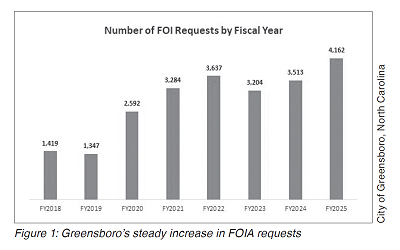 I’ve answered public records requests for Greensboro, a pretty midsize city in central North Carolina, since 2018. We comply with North Carolina’s Public Records law, our version of FOIA. James Madison would rejoice at the biggest change I’ve observed: a steady increase in requests (see Figure 1). Why? Greensboro’s growth is one answer; another is our user-friendly records request portal. We make it easy for everyone, even those without knowledge of freedom of information laws, to get our records. I’ve answered public records requests for Greensboro, a pretty midsize city in central North Carolina, since 2018. We comply with North Carolina’s Public Records law, our version of FOIA. James Madison would rejoice at the biggest change I’ve observed: a steady increase in requests (see Figure 1). Why? Greensboro’s growth is one answer; another is our user-friendly records request portal. We make it easy for everyone, even those without knowledge of freedom of information laws, to get our records.
I’ve seen paper records almost vanish since 2018. Instead, I email electronic records to requesters, who are happy to receive them so quickly, and I avoid copying and postage costs. However, I, like those at all government agencies, must search proliferating digital storage pigeonholes. Think applications, databases, messaging apps, smartphones, devices, social media, video meetings, and AI tools, with more to come. My successors will need skills in e-discovery, AI, and data governance.
I’ve seen the laws that exempt confidential information from public access change too. For example, I watch for new court decisions about North Carolina’s Driver’s Privacy Protection Act of 1994, which protects licensed drivers’ personal information from scrutiny. On the national level, we see the evolution of restrictions on access to student-athletes’ name, image, and likeness contracts. Lawmakers and courts recurrently shift the balance between the public’s right to know and personal privacy protection.
FOIA experts have witnessed change at the federal level too. In an email, professor Margaret Kwoka, Frank R. Strong Chair in Law at Ohio State University’s Moritz College of Law, said the biggest change is “the exponentially rising number of FOIA requests submitted to the federal government each year. The reality is that agencies are not adequately resourced to keep pace with the public’s use of [FOIA], and volume alone poses huge administration challenges.” David Cuillier, director of the Joseph L. Brechner Freedom of Information Project at the University of Florida, said in an email that he witnessed “many amendments that have improved the system incrementally.” Nancy Kranich, teaching professor at Rutgers University–New Brunswick’s School of Communication and Information, said in an email, “I was proud to help Congress pass the Electronic FOIA Records Act in 1996, which paved the way for the virtual future government information world, supplemented by the 2016 [Act] that streamlined public access, and the addition of a FOIA Ombudsperson—essential to promoting best practices across the government.”
THE NEXT 60 YEARS OF FOIA
For Wagner, in the future, the American government should make all public records available online from the moment of creation. “The idea is that records have to live online,” he told me. Congress inserts “expectations and guardrails” into FOIA for protection of confidential personally identifiable information, and agencies use AI to automate those expectations. “The government needs to move away from a zero-tolerance policy for accidental releases of exempt information and accept it will happen,” Wagner said. What will FOIA be in another 60 years? “I hope there are very few requests, and everything is online. I want to live in a world where everything is easily available,” he noted.
Kranich said, “The more the government makes public (i.e., publishes), the less it needs to rely on costly, cumbersome processes to respond to requests for public information. Ideally, we should support efficient, streamlined record-keeping and dissemination programs sponsored by the U.S. government to minimize delays and barriers to open access.” Kwoka pictures three-pronged access. Federal agencies proactively disclose records and information often requested by the public. Citizens use a confidential access procedure, different from FOIA, for personal records like personnel files. Journalists, watchdogs, and oversight groups turn to FOIA pipelines reserved for them.
When asked about a change Congress could make now, Kwoka suggested “a model of oversight that allows a specialized agency like an information commission to resolve FOIA disputes rather than forcing requesters to resort to federal court.” These independent information commissions are found in other countries—the U.K. has its Information Commissioner’s Office—where they resolve freedom of information disputes with “faster and more transparency friendly” decisions. Cuillier agreed and said such a commission “improves the ability for average people to get the information they need to improve their lives and communities.”
SUNSHINE WEEK 2026
 Sunshine Week is the annual celebration of open government. It always coincides with March 16, which is James Madison’s birthday. The Joseph L. Brechner Freedom of Information Project coordinates a public relations campaign and a wonderful website, sunshineweek.org, with advice for FOIA requesters, a social media toolkit, and even editorial cartoons. Sunshine Week is the annual celebration of open government. It always coincides with March 16, which is James Madison’s birthday. The Joseph L. Brechner Freedom of Information Project coordinates a public relations campaign and a wonderful website, sunshineweek.org, with advice for FOIA requesters, a social media toolkit, and even editorial cartoons.
The Joseph L. Brechner Freedom of Information Project, MuckRock Foundation, and National Freedom of Information Coalition hosted Sunshine Fest in Washington, D.C., March 15–17, 2026, which is a highlight of Sunshine Week. Sunshine Fest is a conference where FOIA experts discuss “solutions to pressing problems in freedom of information across all disciplinary and geographic boundaries—local, state, federal, and global!” Sunshine Fest included a plenary session called Big Ideas for Improving Freedom of Information. In the panel discussion, Bobak Talebian, former director of the Office of Information Policy in the U.S. Department of Justice, said federal agencies face two challenges: finding skilled FOIA experts and funding FOIA. “A lot of agencies don’t have the resources to keep up,” he said. “Now, more than ever, we need to modernize FOIA.” Talebian wants the modernization of FOIA customer service and records production. He described FOIA Wizard, the first federal requester interface to use machine learning. “It’s designed as a tool for everybody, even those who don’t know about FOIA.”
The Big Ideas Crowdsource Competition List proposed ideas for the future of FOIA, including:
- The U.S. government spends at least 1% of its budget on FOIA and records management.
- All federal employees have FOIA as part of their job duties.
- Federal agencies’ websites feature AI chatbots to clarify requests.
- Whenever an agency answers a FOIA request, it posts responsive records online in an open format.
- The U.S. government establishes a small-claims court for FOIA litigation.
Also at Sunshine Fest, The Journal of Civic Information announced the winners of its FOIA research competition. It will publish the winning papers in its special 60th anniversary of FOIA issue. Frank LoMonte, legal counsel for CNN, said he wants the U.S. government to adopt a duty to document in his winning paper, “Data Deserts and the Duty to Document.” FOIA requires agencies to disclose existing records and information, but doesn’t require agencies to create new information just because someone asks for it. Many important datasets simply don’t exist, wrote LoMonte. A duty to document would require agencies “to affirmatively create the datasets that the public most needs to see for effective government oversight.” He believes the U.S. Congress could amend FOIA “to encompass not just documents that exist, but documents that should exist.”
“AI Meets FOIA Law,” a winning paper by Erin Coyle, associate professor in the Cronkite School of Journalism and Mass Communication at Arizona State University, and Eric P. Robinson, associate professor in the College of Information and Communications at the University of South Carolina, proposed protocols for AI use for responses to FOIA requests. They said that federal agencies must continuously train AI tools with new court opinions, agency decisions, and laws. They must keep humans in the loop too. FOIA staffers must check the AI for compliance and integrity.
FUNDING THE FUTURE OF FOIA
These improvements, especially technology, cost money. At Sunshine Fest, many speakers asked for more federal investment in FOIA. There’s been good news. At the March 5 meeting of NARA’s FOIA Advisory Committee, its subcommittee on statutory reform recommended that Congress amend FOIA to require federal agencies to assign part of their budgets for FOIA “proportional to the size of the workforce served by the [agency’s] FOIA Office” and set a minimum level of FOIA funding for all agencies, even small ones. With these changes, FOIA would enjoy sufficient funding.
LIBRARIANS AND FOIA AWARENESS
Over the next 60 years of FOIA, public support is necessary for FOIA to change and grow with the times. Librarians, who are experts at outreach to the public and finding information, can assist. For example, the Kalamazoo Public Library in Michigan hosted a FOIA Fest on March 21. Celebrate Sunshine Week, use the tools on the Sunshine Week website, and help patrons know the power of FOIA. As James Madison wrote in 1822, “Knowledge will forever govern ignorance: and a people who mean to be their own governors, must arm themselves with the power which knowledge gives.”
|