FEATURE
A Comparative Analysis of Public Library Generative AI Policies
by Chris Evjy
Libraries Analyzed
This analysis synthesizes AI policy documentation from 16 public library systems:
- Arapahoe Libraries in Colorado
- Boulder Public Library District in Colorado
- Columbus Metropolitan Library in Ohio
- DeKalb Public Library in Illinois
- Edmonton Public Library in Alberta, Canada
- Galena Public Library District in Illinois
- Hastings Public Library in Nebraska
- Houston County Public Library in Georgia
- Kalamazoo Public Library in Michigan
- Kaukauna Public Library in Wisconsin
- Kenosha Public Library in Wisconsin
- Kent District Library in Michigan
- Pickerington Public Library in Ohio
- Pioneer Library System in Oklahoma
- Seattle Public Library in Washington
- Toronto Public Library in Ontario, Canada
|
This analysis synthesizes AI policy documentation from 16 public library systems. ... The prevailing posture across libraries is ‘responsible innovation,’ although the spectrum of risk tolerance remains wide.
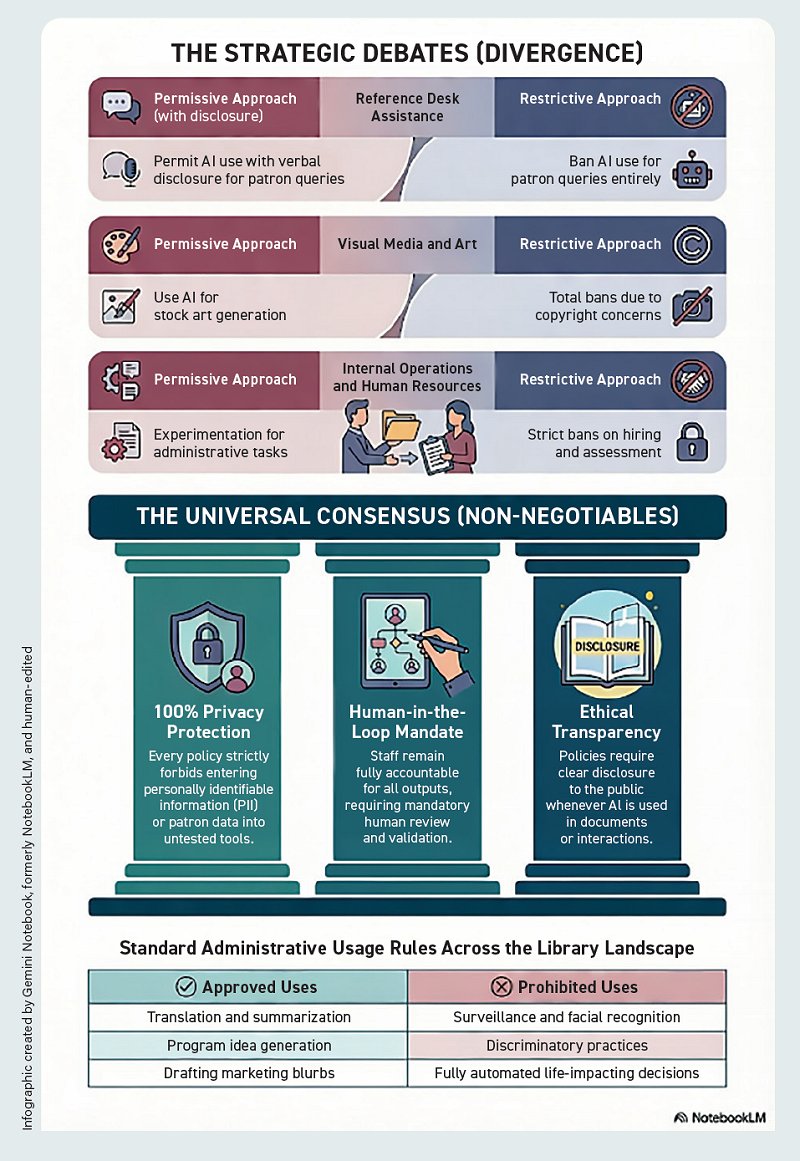
Public library systems are navigating a critical transition regarding generative AI (gen AI). The current policy landscape shows libraries working to balance the operational efficiencies of AI with the foundational library values of intellectual freedom, equitable access, and the protection of patron privacy. The most evolved policies treat AI not as a novelty, but as governed enterprise IT infrastructure. Rather than issuing blanket prohibitions, some libraries are tiering AI tools by risk and establishing robust governance frameworks to evaluate them. While there is absolute consensus on protecting patron data and requiring human oversight, significant philosophical divergence remains regarding AI-generated visual media and the use of AI in direct reference services.
Policy Dimensions Analysis
Overall Stance: Permissive vs. Restrictive
The prevailing posture across libraries is “responsible innovation,” although the spectrum of risk tolerance remains wide.
Permissive/innovation-first— Kent District Library encourages staff to “experiment without fear,” viewing trial and error as essential to professional growth. Arapahoe Libraries proactively seeks to use AI to automate tasks and create efficiencies. Edmonton Public Library and Seattle Public Library acknowledge the transformative potential of AI and have established structured processes to safely integrate it into their work.
Restrictive/precautionary— Houston County Public Library frames the unapproved scraping of internet data by AI models as “intellectual theft.” Kaukauna Public Library explicitly prohibits its staff from using AI systems to answer patron reference questions or staff queries related to their jobs due to the danger of hallucinations.
Data Privacy: Specific Protocols for Patron Data and PII
There is universal consensus on protecting patron confidentiality.
Strict prohibitions— Every analyzed policy forbids inputting personally identifiable information (PII) or confidential patron data into unvetted AI tools. Libraries including Columbus Metropolitan Library, Kalamazoo Public Library, and Pickerington Public Library explicitly define PII (e.g., library card numbers, borrower history, birth dates) in their policies to remove any ambiguity.
Enterprise exceptions— Edmonton Public Library and Kenosha Public Library allow confidential staff data or operational data to be entered only into approved, vetted enterprise AI systems subject to strict usage scopes and executive approvals.
Human Oversight: Human-in-the-Loop Requirements
AI lacks empathy and professional judgment. Staff are ultimately accountable for the content they produce with the tools they choose.
Verification and accountability— Pioneer Library System emphasizes that AI serves as a tool for support, but it never replaces librarian knowledge and decision making. Hastings Public Library mandates that staff “always review and validate” AI-generated results.
Empathy and high-stakes decisions— Columbus Metropolitan Library dictates that for sensitive communications (such as condolence letters or performance assessments), AI may only be used for grammar and structure, preserving human empathy. Toronto Public Library emphasizes that decisions impacting people’s lives should never be fully automated.
Managing Risk: Vetting Processes for Third-Party Tools and Security
Approaches to risk management vary greatly.
Framework alignment— Kenosha Public Library aligns its AI vetting process with the National Institute of Standards and Technology (NIST) AI Risk Management Framework ( nist.gov/itl/ai-risk-management-framework). Toronto Public Library requires an IT security assessment, an AI privacy impact assessment, and a human rights AI impact assessment before deployment.
Governance committees— Seattle Public Library uses an AI Governance Committee that requires vendors to submit an AI fact sheet detailing technical model information before a tool is approved.
Opt-out settings— Hastings Public Library directs staff to opt out of data tracking and training features when registering for free AI tools.
Public Transparency: Disclosing AI Use
Transparency is treated as a matter of professional ethics and public trust.
Written disclosure—Edmonton Public Library suggests a standardized disclaimer: “This document was prepared with the assistance of AI tools.” Seattle Public Library requires highly detailed attribution, including the specific model used (e.g., OpenAI’s GPT-3.5) and confirmation of human review.
Reference interactions—Kenosha Public Library requires staff to verbally disclose AI use to patrons during reference interactions and to document it on patron question forms. Kalamazoo Public Library similarly requires staff to inform patrons when AI assists with their inquiries.
Usage Rules: Approved vs. Prohibited Use Cases
Policies draw clear lines between acceptable workflow streamlining and unethical applications.
Approved uses— Generating programming ideas, writing code, summarizing documents, translating, and drafting marketing blurbs are widely approved uses.
Prohibited uses— DeKalb Public Library, Kalamazoo Public Library, and Seattle Public Library explicitly ban AI for surveillance, facial recognition, and discriminatory practices.
Contested uses (images)— Houston County Public Library bans the publication of AI-produced images entirely due to copyright and intellectual theft concerns. Conversely, Kent District Library permits AI image generation as a substitute for generic stock art, although it prefers authentic photography of real patrons. Kenosha Public Library prohibits using text-to-image AI tools to generate entirely original images, but allows them for generating components of a larger work.
Community AI Literacy: Educating the Public
Forward-thinking libraries view AI as a critical new frontier for information literacy and digital equity.
Educational mandates— Arapahoe Libraries includes education as a core strategy, teaching patrons to navigate AI biases and understand tool weaknesses. In its AI policy, Galena Public Library District frames this as part of its “lifelong learning” mission to provide guidance in a “world affected by augmented reality.”
Literacy targets— Kenosha Public Library outlines specific AI literacy targets, including teaching the public about algorithmic bias, data privacy, and distinguishing between human-made and AI-generated works.
Collection Impact: Policies Regarding AI-Generated Books or Media
Policy gap— While DeKalb Public Library mentions using AI to assist patrons in retrieving information from catalogs, and Toronto Public Library notes the need to monitor AI’s impact on data management and preservation, none of the 16 analyzed policies explicitly outline rules for acquiring, cataloging, or labeling AI-authored books or media within the circulating collection.
Infographic created by Gemini Notebook, formerly NotebookLM, and human-edited
POLICY DIMENSION |
CURRENT LANDSCAPE |
ANALYSIS |
Patron data
and privacy |
Consensus
(with minor divergence) |
Agreement: Universal agreement exists that policies strictly prohibit entering personally identifiable information (PII) into public AI models to uphold library privacy values.
Divergence: Divergence occurs regarding confidential staff data; some systems allow inputting internal operational data into paid or private enterprise instances with executive approval, whereas others maintain a total ban. |
Human-in-the-loop and accountability |
Consensus |
Universal agreement that staff must review, edit, and validate all AI outputs. The human employee is fully liable for the output. AI lacks professional judgment and cannot replace the human, particularly in sensitive communications or high-stakes decisions, which policies dictate must never be fully automated. |
Image generation |
Disagreement |
Some institutions strictly prohibit AI image generation entirely due to copyright and intellectual theft concerns. Conversely, other libraries permit it for generic marketing or as an acceptable alternative to stock art. |
Tool whitelisting and vetting |
Disagreement |
Approaches to risk management and tool access vary widely. Some libraries restrict staff usage to free, preapproved tools only, whereas others encourage open experimentation “without fear” to build staff competencies. Several institutions are moving toward paid, licensed enterprise environments to actively mitigate security risks. |
Reference services |
Disagreement |
Some libraries explicitly prohibit using AI to answer patron reference questions. In contrast, other systems allow AI to enhance information searches, but require staff to independently verify answers, verbally disclose AI usage to the patron, and document AI use. |
Bias and human resources usage |
Disagreement |
Policies diverge on internal operational applications, despite a baseline consensus that AI outputs are inherently biased and must be scrutinized. Specific policies explicitly prohibit using AI for human resources screening, hiring, or disciplinary actions, whereas others don’t mention this issue. |
Sustainability |
Disagreement |
The environmental impacts of generative AI (gen AI) and training large language models (LLMs) are largely absent from the policy landscape, with only a very small minority explicitly mentioning environmental impact as a policy consideration. |
This article is licensed under CC BY-NC 4.0. NotebookLM (now Gemini Notebook) was used to draft this analysis. |