|
MARKETING LIBRARY SERVICES
Gaining Funding and Support for Library Marketing
by Kathy Dempsey
| When you’re suggesting a promotional campaign that directly aligns with an important strategic goal, you’re more likely to get the funding and support you seek. |
People of a certain age will remember the comedian Rodney Dangerfield. His schtick was built around the phrase, “I don’t get no respect.” Library marketers often feel the same way. Certainly, no department feels like it has an abundance of funding or support. But in marketing and communication, workers can feel like they must claw for every dollar. And respect? The lack of it is definitely not funny. (But Dangerfield was! Here’s a taste: instagram.com/reels/DChGy-bO6zS.)
Some staffers who do marketing communications (marcom) work have a budget of zero dollars, yet they’re expected to promote everything their library systems have to offer. Many feel as if their work is an afterthought, especially when others plan all of the details of an event and then ask for marketing as the final step—and expect miracles. How can you improve situations like these? I’ve amassed a number of strategies by talking with many discouraged marcom people and by looking closer at stories of others who made progress.
Get to Know Them and How They Communicate
It’s hard enough to ask for money when the budget is tight. It can be even harder if the person you need to ask doesn’t view you or your work favorably. So if you’re in a situation like that, start building relationships. That doesn’t mean you should kiss up to the boss; it just means interacting to help build familiarity and trust. Accept that this will take time.
 Along the way, you’ll build an understanding of the administrators’ world, and you’ll learn about their priorities. This is vital. Because if they’re hyperfocused on a fundraising campaign for the next 6 months, that might not be the best time to ask for money. But if they’re working toward a strategic planning goal of increasing the number of cardholders and you ask for marketing funds to promote Library Card Sign-Up Month, that’s a good fit. When you’re suggesting a promotional campaign that directly aligns with an important strategic goal, you’re more likely to get the funding and support you seek. Along the way, you’ll build an understanding of the administrators’ world, and you’ll learn about their priorities. This is vital. Because if they’re hyperfocused on a fundraising campaign for the next 6 months, that might not be the best time to ask for money. But if they’re working toward a strategic planning goal of increasing the number of cardholders and you ask for marketing funds to promote Library Card Sign-Up Month, that’s a good fit. When you’re suggesting a promotional campaign that directly aligns with an important strategic goal, you’re more likely to get the funding and support you seek.
Here’s something else for you to learn as you get to know whoever is in charge. What do they think of the concept of marketing? For some, the word has a negative connotation. But those very same people might be 100% behind the idea of outreach or community engagement. While those are technically different from marketing, they are intertwined, and the goals are often the same. So if someone doesn’t respect the M word, as it’s been called, then use a word they do like.
While we’re on the topic of language, it’s savvy for you to adopt the words and phrases that the managers or board members use. You need to translate your needs to their chosen language. For instance, if a member of your board or city council will see a written request from you, don’t ask for money for storytime. Call it an early literacy class instead. You don’t want to market a database, you want to drive usage to make the most of expensive resources. You don’t want to bring more kids to the library, you want to increase the library’s ROI for its children. You get the picture.
Speaking of expensive databases, I have a favorite talking point that can help others see your requests in a new light. Try something like this: Why spend $50,000 on this major database, then spend absolutely nothing to tell people it’s here and to encourage them to use it? (I have yet to hear a satisfactory answer to that question.)
Make Your Case With Data, and Start Small
Unfortunately, I still hear some marcom workers tell me that their leaders don’t believe in marketing enough to dedicate staff time and money to it on a regular basis. It’s tough when you’re up against that, but remember: Librarians are information people. They’re usually logical and can be convinced by data. So go dig up some case studies, reports, and articles. (See the sidebar below to get you started.)
Stories and testimonials can be very powerful. You can make your case even stronger by getting stories from libraries that resemble your own in size, population area, and budget. Don’t be afraid to casually appeal to the board’s or bosses’ sense of professional pride: “Here’s a case study and two articles from similar libraries in our region. This is evidence that even a small amount of funding, spent carefully, can make a big difference. And if they’re getting more attention, we don’t want to lag too far behind.”
Everyone wants to be liked, right? Comedian Rodney Dangerfield knew that. He quipped, “I tell ya, I don’t get no respect. Once on my kid’s birthday, I took him to Coney Island. I said, ‘Kid, it’s your day. Here’s $20, do whatever you want.’ The kid took a cab home.” Don’t be afraid to play to your management’s desire to be liked and respected.
If you’re dealing with people who are suspicious of marketing or people who think it means selling the library, it will take effort to win them over. That’s why it’s a good idea to start small, prove your success, and then incrementally increase your requests over time. Think of something that could offer great value for very little money; perhaps a $25 prize to entice people to complete a task. If you’re asking patrons to renew their library cards in September, make every renewal an entry that can win a prize. If you get the word out, your numbers will go up.
Prove Your Need for Staff Time and Support
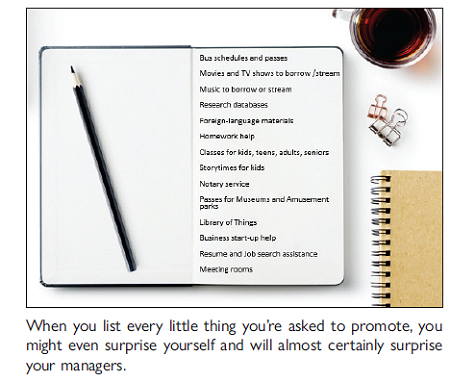 Money is wonderful, but you also need staff time and some backup support. Whether you do marketing communication full time or part time, it’s likely that your superiors have no idea how many things you handle. So, show them; tell them. Money is wonderful, but you also need staff time and some backup support. Whether you do marketing communication full time or part time, it’s likely that your superiors have no idea how many things you handle. So, show them; tell them.
Make two lists. One will be for everything you actually do (15 fliers a week for the children’s department, three a week for adult services, 20 social media posts across four platforms every week, promoting the seed library all spring, etc.). Then make another list of all of the promotional tasks that the staffers want you to do. There are always more requests for marketing than a person or team can handle. Rather than complaining about it, make these demonstrative lists to show just how much more promotion could be happening. And if program planners complain that people didn’t show up because (they think) you didn’t do enough marketing, make note of how often that happens too.
It’s likely that every person and department want more hours and money. But how many of them will take the time to list every task left undone and discuss how the library is less used and less successful because of that? (I realize it seems ridiculous to suggest that you spend time making lists when you don’t have enough time for your actual work. I’ve been there. If you think there’s a chance of your request being fulfilled, then it’s worth taking some of your own time to put your data together.)
Here’s a bonus idea: If possible, ask front-line staff to mark down each time a visitor says, “I didn’t know the library did that!” or “I wish I knew you were offering that class; I’d have signed up.” If you can show that this happens a lot, it’s extra proof that more time and effort spent on promotion can make a real difference in library usage.
Take the Initiative
Many leaders like people who take the initiative and go a little beyond expectations. So, if you want to ask for something, make it a well-thought-out request. Show them that your idea is possible and what it would take to make it happen. Show them why it’s important. In other words, don’t make a vague request. Come in with a plan sketched out. What do you want to achieve, and how will it support the library’s goals or mission? What are your goals for the event, program, or campaign? Research how much things could cost.
Another avenue to pursue is grant money. You can show how badly you want something if you begin looking for funds before presenting your idea. Part of your plan could list potential sources of funding, such as national grants, local awards, or partnership input. And don’t overlook the value of non-monetary support, such as in-kind advertising or space to use at partner locations.
Marketing and Communication Work Deserves Respect
Remember, you’re not Rodney Dangerfield. You should never be at work saying, “I don’t get no respect.” Be assured that you and your work deserve respect and funding!
Finally, of course, don’t give up. We’ve all heard the stories of award-winning authors whose books were rejected by 10 publishing companies before they were accepted. This isn’t so different. If you can be a savvy communicator, and you can back up your requests with data and show initiative, then you have a good chance of slowly but steadily building enough funding and support to take your library’s marketing communication to the next level.
|