|
MARKETING LIBRARY SERVICES
Creating Homegrown Swag via a MakerLab Collaboration
by Bryan Field
| Staffers at Binghamton University’s libraries explored an idea with the coordinator of a new makerspace. |
The beginning of a new semester at a university is a high-energy time. After a summer or winter hiatus with peaceful grounds and plentiful parking spaces, the campus is suddenly filled with students who are excited to connect with friends and explore. On the professional side, the first week of class is a crucial time to connect with students, new and old, by sharing fun facts, resources, and new initiatives. For libraries, the urgency is no different from that of other departments, and competition to connect with students in a unique way—especially through giveaways—is sometimes brutal.
Since 2022, I have served as the communications officer for Binghamton University’s libraries, and the question of “What new swag should we offer?” is something we dread. Do we go all in on a unique idea such as a trendy sticker or fidget spinner, only to have leftovers for years to come? Or do we take the easy road and order branded pens that we never seem to have enough of?
We had an idea that had been percolating in the background for a couple of years, and finally, in early 2025, the pieces of it fell into place. As a result, we were able to create an impactful takeaway item that integrated simple technology, promoted a new library resource, and could be designed and produced in-house.
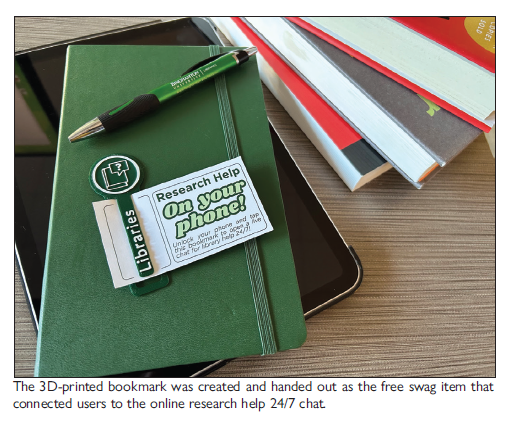
In collaboration with our brand-new MakerLab, we created a 3D-printed bookmark that uses near-field communication (NFC) technology to connect users to a personal service. Students can tap our bookmarks on their phones to open our 24/7 research chat and to connect with the library no matter where they are, no matter the time. It is like having a personal librarian right on your phone.
A Commonplace Inspiration
About 2 years ago, I got the idea to have a figurine of sorts that, when you tapped it on a device, connected the user to the libraries. Being familiar with gaming consoles, the inspiration came from Nintendo Amiibo figurines. These little plastic characters are a novel way for gamers to support their favorite video game in a physical tchotchke that, when hovered over a game controller, unlocks an in-game bonus feature via an NFC chip embedded in the toy. Fast-forward a few years, and NFC technology is integrated everywhere through the popularization of the tap-to-pay function of most credit and debit cards.
With 3D printers coming on the market for at-home hobbyists, I thought that it would be a neat concept to use a trendy product for some sort of marketing ploy. A colleague who had his own 3D printer was more than happy to explore this idea with me. We designed a simple figurine of an Instagram icon resting on an open book attached to a base that included the NFC sticker. Perhaps this could serve as a “stamp” that would help students connect with the libraries’ Instagram page with a quick tap of their phones.
Early testing was a mild success, but it did bring up some logistics to consider. First, the thickness of the base seemed to affect how well the NFC tag was read by the phone device. It seems intuitive enough that several layers of plastic would affect how well radio waves could pass through an object. Second, we quickly found out from sharing our excitement with other colleagues that not all phones at that time could automatically read NFC tags. We discovered that the latest version of an Apple or Android phone seemed to have this technology readily available, but older models did not.
Even with those setbacks, we knew we had a proof of concept that we could continue to develop. Then, like all good projects, it was put on hold to prioritize other things. In our case, they included (but were not limited to) welcoming a new dean, making staffing changes, and opening the newly remodeled third floor in our main library.
New Opportunities Reignite Innovation
In January 2025, the university’s libraries expanded their research help desk chat offerings by joining Ask Us 24/7 (askus247.libanswers.com), a service provided by the Empire State Library Network (esln.org). More robust than a single library could provide, the 24/7 human-powered resource facilitated questions regarding our provided collections or general research support. While this was a big win in meeting students where they are, the drawback is that it was only accessible via the libraries’ website.
Shortly afterward, the university’s libraries officially opened the newly renovated third floor of our main building. The floor featured new study spaces integrating technology alongside the collections. Additionally, it included a new location for a Digital Scholarship Center, Recording and Data Studio, and a brand-new MakerLab. Branded as a space where technology meets curriculum, students and professors were encouraged to fabricate their ideas into tangible items using wood laser cutters, Cricut machines, 3D scanners, and 3D printers. To promote the new resource, a MakerLab student employee designed and created a 3D-printed, clip-style bookmark as a giveaway. As the events of early 2025 unfolded, the pieces seemed to fall into place: We had a new resource to promote and a new space to help make it happen. After a conversation with the newly hired MakerLab coordinator, Chung Park, to float the idea of partnering, he was instantly on board.
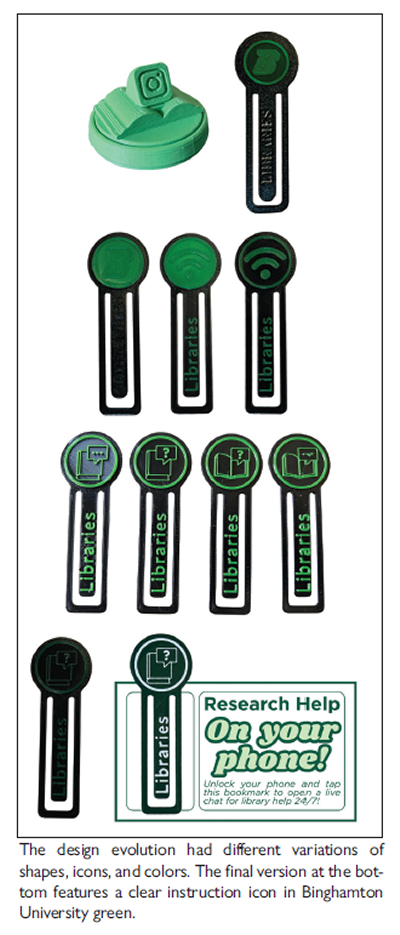
Throughout the summer, we worked on prototyping variations of the original bookmark design. Our design variations were partially aesthetic, such as shifting which logo to use or which color filament to print it with. We also had to figure out technical considerations (e.g., would the temperature of the heated filament damage the microchip embedded inside). After working through the different design aspects, we were able to settle on one that clearly communicated the intent of the giveaway. Soon, we got into producing the bookmarks en masse.
Manufacturing Swag With a 3D Printer
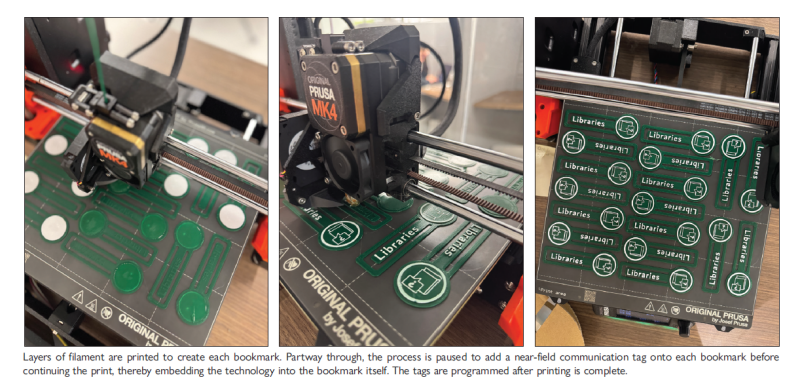
The bookmarks were designed in Fusion 360 software to optimize 3D printing with an NFC tag insert. After finalizing the swag's design, we created small instruction cards to be held in the bookmark’s clip. Then we began printing, programming, and assembling the bookmarks. We utilized the Original PRUSA MK4 fused deposition modeling (FDM) machines with polylactic acid (PLA) material for filament. The PLA material has a durable plastic feel, but it is flexible enough (within reason) to clip onto a couple of pages without breaking.
To start, the 3D printer would lay down two layers of filament and then pause for the NFC stickers to be placed by hand in the middle of each round part of the bookmark. Next, the printer continued laying down the rest of the design directly on top of the first two layers, embedding the sticker in the bookmark itself. Then we’d switch the filament color from green to white and continue the job to add the final details to the bookmarks, including the “Libraries” label on the stem and the research help icon where the NFC sticker is located. A single print job yielded 20 bookmarks in about 2 hours.
The printing was completed in the MakerLab, then delivered to me so I could program the NFC tags that had been embedded in each bookmark. Programming each item was made easy by an NFC read/write app called NFC Tools (apps.apple.com/us/app/nfc-tools/id1252962749). Free to download, the user-friendly app allowed me to input the desired URL to direct the user to and then individually program the sticker with the push of a button and the scan of my phone. Once the app was set up, each bookmark took less than 3 seconds to program.
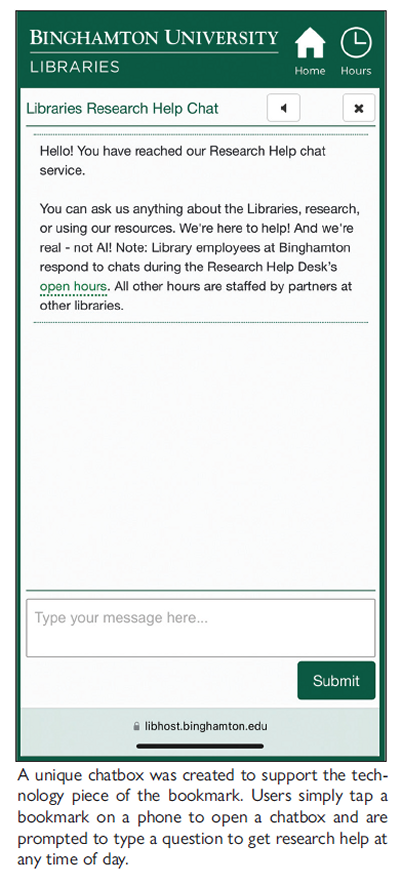
The last piece of the puzzle to make this work was to create a separate webpage for a unique chatbox that was exclusive to this project. Since the original 24/7 chat feature was available on the libraries’ website, it did not have its own unique URL. As a result, our web designer created a unique URL that would only display the chatbox on a phone after the bookmark was scanned. Because the separate webpage was created in-house, we were able to optimize the chatbox for mobile devices as well as customize it to display the libraries’ logo, a button to its homepage, and a clock button linked to our library hours. The end result resembled an interface similar to a messaging app, making for a familiar user experience.
Swag Distribution and Promotion
The initial goal was to have about 800 bookmarks available for distribution at the beginning of the fall 2025 semester. Because this was the main swag item for the year, there was a big push to hand them out at new-student orientation, first-week-of-class tabling, and general outreach events as well as at our access services and research help desks at each of our library locations. The initial response to receiving the bookmarks was positive, as each student was impressed by how a simple, unassuming item could feature something so technological. Once students understood the deeper purpose of the bookmark, the immediate response was to take out their phones to test it out. This interaction usually ended with a “That’s so cool” or some other affirming exclamation. As part of my regular outreach to the admission tour guides, we gave 100 bookmarks to them to showcase our new research help tool and to tout the capabilities of our new MakerLab space.
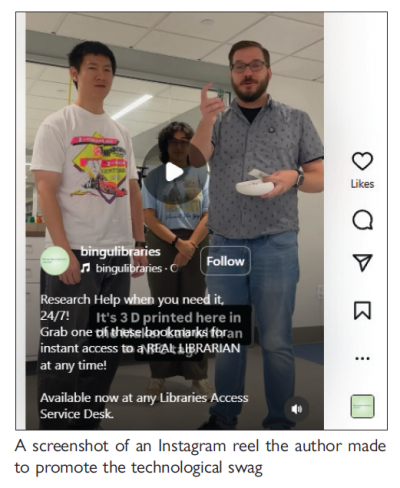 After the initial distribution of the bookmarks during the first few weeks of the semester, the promotional strategy shifted to maintaining stock at key locations and promoting the giveaway on social media. We had bookmarks available at the main service desk at each branch location as well as at the MakerLab itself. In collaboration with my student employees, we made an Instagram reel, following a popular meme, of having me share my “special interest” (instagram.com/reels/DQSxeBRjM0v). With the busyness of the semester, this more passive strategy was helpful to get bookmarks in the hands of those who would naturally come to the desk to ask for help. Out of the 800 bookmarks we printed, I estimate that around 600 were taken. We kept the leftovers for the spring semester and printed 1,000 more. After the initial distribution of the bookmarks during the first few weeks of the semester, the promotional strategy shifted to maintaining stock at key locations and promoting the giveaway on social media. We had bookmarks available at the main service desk at each branch location as well as at the MakerLab itself. In collaboration with my student employees, we made an Instagram reel, following a popular meme, of having me share my “special interest” (instagram.com/reels/DQSxeBRjM0v). With the busyness of the semester, this more passive strategy was helpful to get bookmarks in the hands of those who would naturally come to the desk to ask for help. Out of the 800 bookmarks we printed, I estimate that around 600 were taken. We kept the leftovers for the spring semester and printed 1,000 more.
Looking forward to the second semester, we planned to distribute the bookmarks again at tabling opportunities during the first week of classes in January 2026. Social media promotion will continue with more pointed advertisements and may expand to include digital sign promotions throughout the library. As more students receive bookmarks and find them useful, we hope word-of-mouth publicity—combined with key advertisements to followers of our social media—will help make this giveaway a unique and impactful resource.
Short-Term Impact, Long-Term Possibilities
After the initial distribution and promotion of the bookmark, the usage results are a bit inconclusive. Based on the number of people who accessed the custom chat page, there were major usage spikes around the first few weeks of the semester and in October. This makes sense given that one of the first things someone does upon receiving the bookmark is to try it out. Looking on the back end at our research chat data, the service received about the same consistent usage. The unfortunate fact about looking at this data is that we cannot separate the queries from where they originated. Whether the question was submitted from the libraries’ website or from the chatbox on a user’s phone, they were treated and tracked the same way.
While the initial data may be inconclusive, administratively, the initiative was considered a success. First, the project helped promote the new research help 24/7 chat line in addition to our typical advertisement efforts through social media posts, blog articles, and digital signage. It provided a unique way for students to learn about this resource and engage with it directly. Second, it helped publicize the type of projects our new MakerLab can support and showed what a collaborative project could look like.
Physically, the bookmark employed techniques commonly used in 3D-printed designs, serving as an easy use case. Also, its creation is a great story to share with others to illustrate how a project like this could move from ideation to collaborative design to implementation, resulting in a final product for distribution. Lastly, the project helped Park, the MakerLab coordinator, test run his own workflow and processes as he prepared for engaging with other professors and students on their own projects. Additionally, with the opportunity to prototype the bookmarks, it helped to test out the 3D printing machines and calibrate them, as well as get a better sense of the effort involved in this size of a project. By working with an internal colleague, he had the opportunity to learn from challenges, both mechanical and collaborative, in a low-risk environment to inform him for the future.
The long-term aspiration of this project is to keep it going. With only one semester since its launch, the short-term goal is to continue to print and distribute bookmarks as our promotional swag for the upcoming spring and summer semesters. Being relatively inexpensive and easy to produce in a short amount of time, the bookmarks can continue to be a reliable and unique giveaway item. Ultimately, the idea is that the more students who have this technology on hand, the easier it is for them to access library resources. Looking into the functionality of the bookmark and how the chatbox is accessed through the NFC tag, it is worth exploring how we can better track usage of the actual bookmark. By better understanding its usage, we can identify gaps in our outreach efforts and try to determine how many students prefer accessing the reference service via the bookmarks over the website.
 |
 |
As an expansion on this project, it could be beneficial to identify other ways to use this 3D-printed and NFC-scanning technology to promote other resources or to make our workflow a little easier. We’re considering keychains that connect to our Instagram profile, a coin that links to our library hours, or a figurine that can check students into events or link them to a post-event survey. This bookmark project started as a what-if idea and, after several years of percolation, it took the right resources, the right collaborators, and the right time to get it off the ground. The end result is a modern, unique take on what libraries have always been here to do: provide access to information to the ones who seek it. |