FEATURE
AI Deep Research and Why the Old School Has Closed
by Arthur Weiss
Online research has changed!
Only a few years ago, researchers depended on web search engines such as Google, specialist sources such as Google Scholar, or free dedicated databases such as PubMed. They had to assess multiple sources themselves, and complex research could take days. The process could be summarized as “Search, Click, Read, Extract, Report.”
Today, such research can often be done in a fraction of the time using the deep research functions in leading AI tools (ChatGPT, Claude, Perplexity, Gemini, Copilot, etc.). The process is now more “Prompt/Ask, Verify, Synthesize.”
Traditional research skills are still needed. What the AI tools have done is change where they are needed—from a focus on finding information to interpreting and validating it. However, the researcher is still responsible for framing the research question and ensuring the output is accurate.
WHAT IS AI DEEP RESEARCH?
Deep research involves searching, reading, comparing, and synthesizing information to produce the required output. AI deep research means that the AI tool carries out much of this process, breaking complex queries into smaller steps, searching multiple sources, and consolidating the results into a coherent answer.
The results from deep research also differ from traditional search engine results. Instead of a list of links, it produces a coherent narrative answering a complex question. It should also be distinguished from agentic research, which can add a level of autonomy and action, fulfilling tasks such as running code, creating output used to test hypotheses, accessing subscribed databases, populating spreadsheets, producing slide decks, or even creating dashboards with end user-adjustable parameters.
CARRYING OUT A DEEP RESEARCH PROJECT
Deep research projects can be categorized this way:
- “Original research,” in which the aim is to gather knowledge about a topic that is unfamiliar
- “Ongoing research,” in which the aim is to verify
or refute existing information and to dig deeper
to develop existing knowledge
Both require full-context prompts and usually iteration, especially for original research, when the researcher has little prior knowledge.
One approach includes using two prompts so that the second functions as a counter-prompt, asking for arguments against the information included in the answer to the first prompt. This is particularly important for the “original research” type project, since verification is harder when there’s little knowledge of what’s true or false. You can also give the same prompt to different AI tools—a feature using Perplexity’s Model Council, which is available with enterprise and some premium subscriptions.
When prompting for deep research, it’s important to select the right mode. “Deep research” normally involves searching, reading, and citing external sources, while “deep thinking” or extended reasoning modes spend more time analyzing the problem. Enterprise subscriptions have access to pro versions, such as ChatGPT, claiming “research grade” investigations.
Prompts can also direct the AI tool to suggest sources or areas to research, as well as sites to ignore. As an example, a prompt may specify, “Focus on U.S. sources from 2023 onward; prioritize official statistics, regulator reports, and peer-reviewed papers; exclude Reddit and Wikipedia except as leads; separate facts from assumptions; and list claims requiring verification.”
In addition, don’t just consider what was found but also whether anything was missed. Deep research tools tend to be weak at proving absence: “I found no evidence” may simply mean the tool did not search the right database, language, archive, or paywalled source.
Confidentiality also matters: Internal documents and personal data should not be uploaded unless privacy and licensing terms allow it.
WHERE DEEP RESEARCH CAN GO WRONG
Large language models (LLMs) tend to rely on user-generated content. In October 2025, Semrush research looked at 230,000 prompts and found that Reddit, LinkedIn, Wikipedia, Medium, and YouTube were among the most-cited domains. Taken together, their reported shares amounted to around a third of cited sources, although the share of the top two, Reddit and Wikipedia, had decreased (semrush.com/blog/most-cited-domains-a). Research looking at U.K. news sources found that LLMs tended to be biased toward left-wing sources, in some cases, disproportionately so. For example, although U.K. newspaper The Guardian has a U.K. audience of 20%, it was cited in 58% of relevant ChatGPT answers and 53% of Gemini answers. In contrast, the most trusted U.K. news source, the BBC, was far less visible as a source in ChatGPT and Gemini answers, possibly due to concerns about using copyrighted material (pressgazette.co.uk/platforms/ai-chatbots-answers-cite-narrow-range-of-top-newsbrands-led-by-bbc-and-guardian and technologymagazine.com/news/bbc-vs-perplexity-legal-showdown-looms-over-ai-content-use).
An emerging risk is “source poisoning.” If bad actors seed the web with false but retrievable material, AI systems may repeat it confidently. User-generated sites can be particularly vulnerable when topics are contested, politicized, or health-related.
These factors can be amplified by training data, as well as search indexes, retrieval systems, result ranking, and licensing restrictions. If these are also biased toward particular viewpoints, there is a real risk of source quality bias. LLMs may fail to distinguish between peer-reviewed expertise and minority opinion, resulting in minority views being given equal or even greater weight than mainstream views if the latter are less visible. This can be a problem, even when using multiple tools, if all depend on the same underlying data. The idea that one tool validates another becomes unreliable if both draw on the same resource data.
As well as those mentioned above, there is still the hallucination problem—in which a completely manufactured answer or citation is given as fact. Although these can be (and should be) checked, there is also a human tendency to accept a convincing answer, even if it’s based on weak evidence. If a citation cannot be quickly verified, treat it as suspect.
GUARDRAILS FOR BETTER SEARCH QUALITY
Prompts that explicitly exclude low-value sources, perhaps by asking for research to focus on .gov and .edu domains and peer-reviewed journals, can reduce the risks of poor research. If needed, run two prompts, with the first specifying only high-quality sources and the second not having that restriction. Then, compare the results.
Researchers can also ask the AI tool to argue against its own conclusions to uncover biases or gaps. Also consider specifying a date range, language, or geography to limit material to the relevant areas, as the AI tool may consider only English-language or global data when this isn’t the focus.
It’s also important to match sources to the question. Medical information should feature clinical guidelines and peer-reviewed evidence; legal claims should use legislation, judgments, and regulator material; and business material should be checked against filings, official registers, trade sources, and direct evidence.
Even when following these guidelines, problems may still arise. Thus, it’s key to verify not only sources, but also to sense-check the workflow or search trail, when available. If it looks odd or wrong, it should be corrected. A multi-tool strategy may also help identify differences, which would require further human investigation.
PRESENTATION OF RESULTS
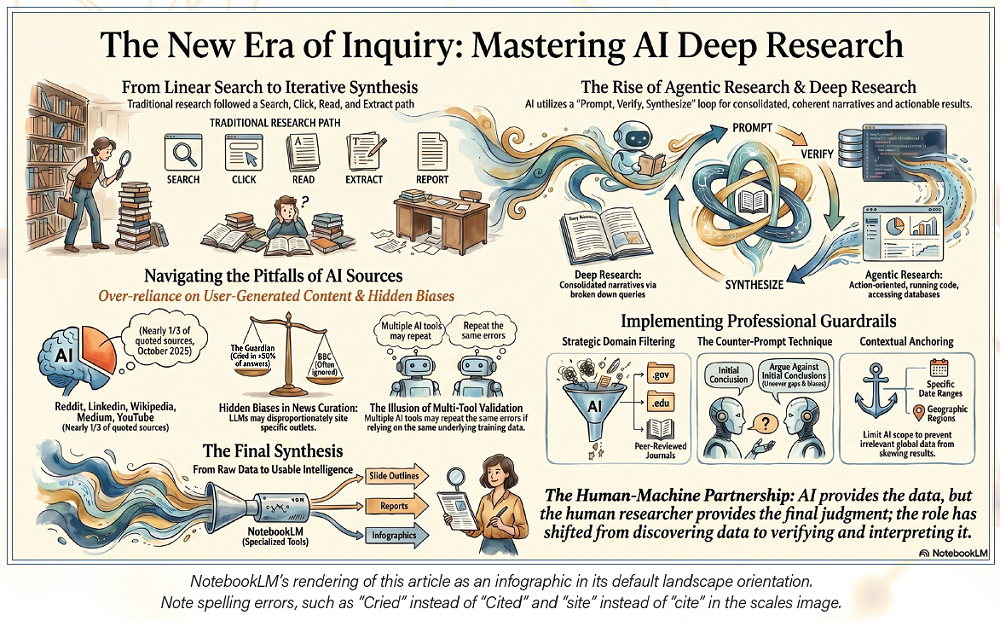
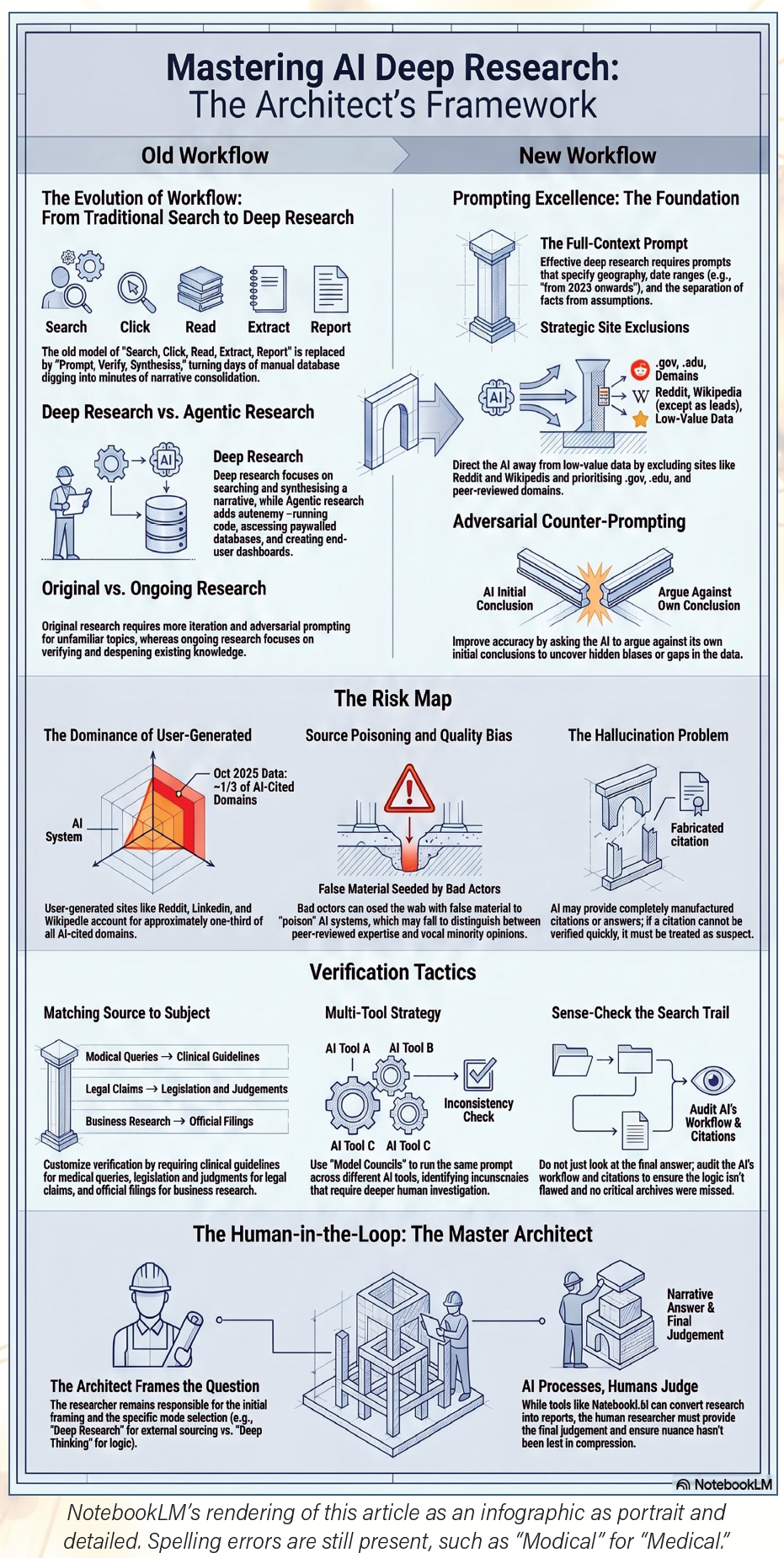
Research is only valuable if it is converted into a usable format. Although AI tools can produce specified formats, NotebookLM (notebooklm.google) is specifically designed to turn input sources (including research results) into reports, slide decks, infographics, and more. To test how well NotebookLM could produce infographics of this article, I created a new Notebook and then, using the article’s text as the source, selected the Infographic tool in the output options. I chose from several designs—orientation (landscape, portrait, or square), level of detail (concise to detailed), and visual style (auto-select or a range including anime, clay, editorial, instructional, and more). I could also have created a slide deck, explainer video, or a podcast with two AI-generated hosts discussing or even critiquing key points.
IMPLICATIONS FOR DEEP RESEARCH
Keep in mind, however, that the presentation doesn’t matter if the underlying research is of poor quality, so ensuring this must come first. Additionally, although NotebookLM reduces some risks by using provided sources, it can still omit nuance, over-compress information, or mis-emphasize points. Plus, as can be seen in the two infographics, spelling is not a strong point of NotebookLM’s graphic creations.
AI deep research massively supports research efficiency—but it’s not a replacement for human expertise. At least for the next few years, the future of research is the human–machine partnership. AI processes data. The human researcher provides the final judgment. The research role has changed from discovering data to verifying and interpreting it.
|