|
MARKETING LIBRARY SERVICES
Leveraging AI for Communications and Development Work in Academic Libraries
by Tywanda L. Cuffy
| My first reaction to using AI was not curiosity - it was resistance. |
It was 6 days before Christmas. I had just wrapped my final project of 2024 and was ready to settle into the holiday season with my family. I found myself in a moment that would quietly reshape how I think about sustainability in communications and development work in higher education. What began as a staffing crisis during a high-pressure publication cycle became my entry point into rethinking the relationship between human creativity and AI.
As director of external relations, communications, and development initiatives for the University of Delaware Library, Museums and Press, my work sits at the intersection of strategic communications, fundraising, marketing, event planning, and institutional storytelling. On any given day, I may be drafting donor-facing campaign language, preparing an annual giving solicitation, developing leadership remarks, shaping messaging for exhibitions and public programs, coordinating stewardship communications, or producing our annual impact report.
What Brought Me to AI
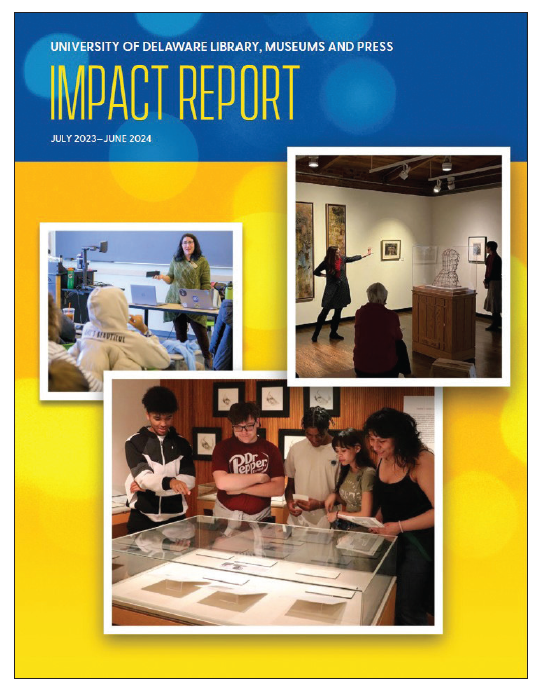
 In late fall 2024, my team had just completed the information-gathering phase for our annual impact report—a 34-page publication capturing the breadth of our work across the fiscal year—when we lost both our in-house staff writer and graphic designer. Their departures came just as we were entering the writing, editing, and design phase. In late fall 2024, my team had just completed the information-gathering phase for our annual impact report—a 34-page publication capturing the breadth of our work across the fiscal year—when we lost both our in-house staff writer and graphic designer. Their departures came just as we were entering the writing, editing, and design phase.
This required immediate recalibration. I identified two freelance partners and divided responsibilities. The freelance writer and I would split drafting. I would lead editing and narrative shaping, and the designer would bring everything together visually. But we were already behind schedule, and coordinating multiple writers, shifting
institutional priorities, leadership edits, donor messaging, and a highly designed publication created a level of complexity that compounded quickly.
Still, we pushed forward. After weeks of drafting, editing, and revising, the report was completed, uploaded, and distributed digitally. The print file sat at the press, ready to be mailed to hundreds of donors, stakeholders, and campus partners.
For a moment, I exhaled. Then came a phone call from a colleague, followed by an email from a faculty member. A reader raised a concern about some language used to describe a student outreach program—a word choice that, while not intentionally harmful, could be interpreted as biased or insensitive. The phrasing had gone unnoticed by senior leadership, including me.
So, there I was, 6 days before Christmas, firing off responses and joining urgent conversations with leadership while most people were preparing to roast chestnuts on an open fire. We developed a plan to address the issue thoughtfully while managing the reality of what had already been published. Fortunately, we were able to halt the print mailing before distribution and make the necessary revisions.
The relief was real, but so was the emotional and mental depletion. Once the crisis stabilized, I found myself on the couch, rehashing everything with my supervisor. I shared what many in communications and advancement quietly carry: the exhaustion of sustaining high-volume, high-stakes work with limited capacity. The constant pressure to produce, refine, respond, elevate, strategize, and tell the story well for different audiences—and to do it all at scale—was wearing me down.
That pressure had intensified with the loss of two key positions. My team and I were depleted. It was during that conversation that my supervisor said something I did not expect: I needed to start using AI—specifically ChatGPT—to streamline parts of my work.
My first reaction to using AI was not curiosity—it was resistance. I was offended. I have a degree in journalism. I was trained to value writing as craft—something deeply human and intentional. My team prided itself on producing thoughtful, original, carefully constructed communications. The idea that a piece of tech could enter that space felt like a challenge to the foundation of how I understood my work. But my resistance was not just about technology—it was about identity.
Many of us who work in communications see writing not simply as a task, but as evidence of expertise, creativity, discernment, and professional value. In a field stretched by shrinking capacity and rising expectations, AI can feel less like support and more like a signal that human labor is becoming negotiable. Beneath skepticism lies a quieter fear: that efficiency might eventually matter more than originality, strategy, human insight, or relationships.
At the time, I did not understand AI. I did not know how to access it or how it functioned. And I certainly did not want to participate in something that, in my mind, risked flattening the artistry of writing.
I wrestled with it throughout the holiday break. My husband—who’s far more comfortable with technology—eventually showed me where to go, how to access it, and how to begin. That moment became my entry point into AI—not as an expert or advocate, but as someone trying to understand whether this tool had any legitimate place in my work. I wanted to believe it didn’t. I was wrong.
My Early Days Using AI
In my early days (and I laugh as I write that phrase because it was only about a year and a half ago), my prompts were basic. I asked ChatGPT to edit leadership remarks I had drafted for my boss or to review a blog post written by a colleague for AP style before it was published on our website. I viewed AI primarily as an elevated proofreading tool.
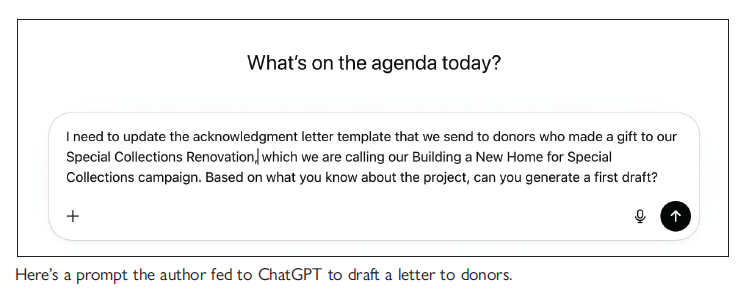
One of my early uses was tightening remarks for a donor event. My prompt was simple: “Please edit these remarks for clarity, grammar, and tone while keeping them donor-friendly and conversational.” The response wasn’t groundbreaking, but it reorganized transitions, tightened phrasing, and softened overly formal language. What struck me was not that it wrote for me, but that it accelerated a process that normally required multiple rounds of quiet, isolated, late-night editing.
Another early use involved annual-giving email language. I prompted ChatGPT to “write a warm but concise Giving Tuesday email soliciting financial support of a renovation project.” The draft was generic, but it gave me a starting place, something to refine into institutionally grounded, emotionally resonant messaging. That was when I realized AI was less useful as an autonomous writer and far more valuable as a collaborative starting point.
Over time, my prompts became more layered. Instead of asking for a single deliverable, I began providing audience context, institutional priorities, tone guidance, campaign goals, donor psychology considerations, a clear call to action, messaging segmentation, and event-specific details. The quality of output improved as the quality of direction improved. I began to understand that effective AI use is not automation—it is structured thinking translated into language.
AI as an Operational Tool in Advancement Work
My use of AI has since become embedded in the operational infrastructure of my communications and development workflow. One key application is campaign architecture, where I have used ChatGPT, Microsoft’s Copilot, and Google’s Gemini to build message hierarchies that translate a single institutional priority into coordinated outputs across segmented donor emails, social media content, website language, and leadership talking points. This ensures alignment across platforms while maintaining a consistent tone and narrative intent. Communications that used to take me days to write and edit were getting done in an accelerated and skillfully efficient way. Let’s look at some examples.
In annual-giving strategy, I use AI to support audience segmentation by generating adaptable messaging frameworks for alumni, faculty members, students, retirees, first-time donors, and lapsed donors. These frameworks allow for calibrated variation in emotional framing, narrative emphasis, and call-to-action intensity while preserving a unified campaign voice.
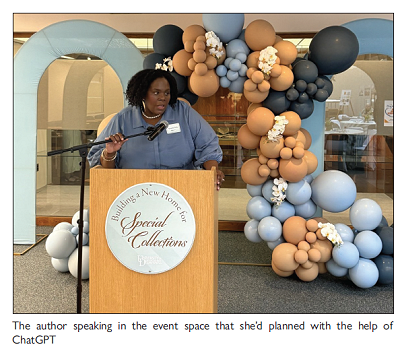
For stewardship communications, AI supports the production of first-draft donor acknowledgment letters and gratitude messaging, which I then refine for accuracy, AP style compliance, and relational tone. In event planning, I use it to develop run-of-show documents, print and digital invitation copy, presentations, and leadership briefing materials that consolidate logistics, messaging priorities, and audience context into a single operational reference. Once, I had a specific idea I wanted to see implemented into a visual design, but without a graphic design background, I feared my creation would fall short. So I described in detail what I was looking to visualize with AI, and it gave me an incredible mock-up to share with a graphic designer who brought it to fruition.
Across these functions, AI operates as a structural support system, transforming unorganized inputs into usable communication assets that improve speed, consistency, and cross-channel coherence while preserving editorial judgment and institutional voice.
From Overload to Alignment
Before AI, I often began with a blank document and a long mental inventory of audience dynamics, institutional priorities, event tone, donor history, leadership voice, and timing constraints—all while managing multiple projects. Now, I can begin with a structured prompt that organizes those variables quickly, allowing me to move into refinement, strategy, and nuance much faster. In less eloquent moments, my prompt truly is an elevated stream of consciousness brain dump.
The work itself has not disappeared. But the cognitive burden of getting started has changed dramatically. I did not anticipate how much relief I would feel once I stopped believing that every meaningful piece of communication had to begin from a blank slate. AI did not remove responsibility, but it reduced the cognitive overload that had quietly become embedded in my professional life. It created space for more strategic thinking instead of constant production.
We are all operating under increasingly unsustainable expectations. Teams are managing expanding responsibilities, compressed timelines, staffing shortages, fundraising pressures, and growing demands for personalized communication—all while trying to maintain quality, creativity, and institutional trust. In that environment, AI is not simply a productivity tool. It is becoming part of how professionals sustain the scale and complexity of the work itself.
There is a misconception that AI cannot handle complexity or nuance. My experience with AI has proven quite the opposite. When given thoughtful direction and strong contextual framing, it can support highly sophisticated communications work. My prompts have gone from a mere few sentences to sometimes pages of original copy and thought.
Ethical Use and Institutional Responsibility
As my use of AI deepened, so did my awareness of the ethical responsibility that comes with integrating it into institutional work. At the University of Delaware, we operate under a formal directive (services.udel.edu/TDClient/32/Portal/KB/ArticleDet?ID=1149) that specifies the appropriate use of generative AI, outlining considerations around privacy, intellectual property, data classification, accuracy, and bias. The policy emphasizes human review, accountability, and ethical oversight.
I am also aware of broader industry concerns: authorship, data sourcing, bias, labor, intellectual property, environmental impact, and the scale of infrastructure required to support AI systems. Because of these concerns, I do not input confidential institutional or donor information into AI systems. Instead, I craft detailed, descriptive prompts to ensure accuracy without compromising sensitive data.
However, the responsibility cannot rest solely on end users. Companies developing these technologies must strengthen transparency, ethical safeguards, and data provenance practices to become far more robust than what currently exists.
Harmony Between Humanity and Technology
Even with its benefits, I understand clearly what AI cannot do. It cannot sit across from a grieving donor whose spouse established an endowment. It cannot navigate institutional politics in a room full of stakeholders with competing priorities. It cannot fully understand the historical weight certain language carries for a community. It cannot intuit relational trust, emotional timing, or organizational culture with the depth that human experience requires. Most importantly, it cannot care. Those responsibilities remain deeply and irreducibly human.
This conversation came into sharper focus during the 2026 ALADN (Academic Library Advancement and Development Network) conference, where I co-facilitated a session titled Harmony Between Humanity and Technology: Libraries Using AI in Advancement. Participants shared how they were integrating tools such as ChatGPT, Gemini, Claude, NotebookLM, Copilot, Otter.ai, and Grammarly into their daily work.
What emerged was not simply a conversation about tools, but about balance. AI is here to stay. The question is no longer whether we use it, but how we define our relationship with it. In my practice, that relationship is grounded in harmony. AI brings efficiency and scale. Humans bring judgment, empathy, ethics, relational intelligence, and strategy. Together, they can strengthen outcomes in ways neither can fully achieve alone.
Over time, I have come to see AI not as a replacement for my work process, but as an extension of it—a system that supports drafting, organizing, and refining while I remain the steward of voice, judgment, ethics, and institutional context.
Looking back at December 2024, I did not realize I was standing at the beginning of that shift. I thought I was simply trying to finish a report under pressure and express my exasperation to my boss. In reality, I was standing at the edge of a larger transformation in how I think about labor, sustainability, creativity, and leadership in higher education. And I am still learning my way through it. And yes—because I know you are wondering—AI did help me edit this article. And sharing that with you brings me both liberation and joy.
|