|
MARKETING LIBRARY SERVICES
Lucky to Be at LMCC
by Kathy Dempsey
| ‘We can hope all day,’ [Kaetrena Davis Kendrick] said. But ‘hope must come with action.’ |
The number 11 has long been a favorite of mine and kind of a lucky number too. That proved to be true again as I attended the most recent Library Marketing and Communications Conference (LMCC; librarymarketingconference.org) in November 2025. The day I flew to St. Louis was Nov. 11; not only was my flight unaffected by the waning government shutdown, but I ended up being the only passenger in a row of three seats. Having room to work and to stretch out was a rare and wonderful bonus.
This also happened to be LMCC’s 11th year. As always, the show went smoothly. The biggest snafu even turned out OK: The second day’s keynote speaker was unable to get there in person due to the many flight delays and cancellations caused by the shutdown. However, her appearance via Zoom was still powerful. I can imagine that the conference organizers didn’t feel too lucky, having to deal with such a big challenge at the very last minute, but from the attendees’ perspective, it all worked out.
Conference Kickoff and Keynote
LMCC began with a half-day pre-conference on the afternoon of Nov. 11. Speakers Leigh Gaddy and Angela Hursh, both from NoveList, presented From Report to Results: Transforming Your Annual Report Into a Year-Long Value Campaign. That evening, many attendees joined the Dine-Arounds to try new restaurants without having to go out alone.
Wednesday morning, Nov. 12, started with a delicious breakfast buffet that gave all 450 conference-goers a chance to connect with old friends and to meet new peers. I’m sure I wasn’t the only person who was hungry to hear the keynote from Scott Bonner, director of the Ferguson Municipal Public Library (FMPL) in Missouri. If either of those names sound familiar, it’s likely because they won national notoriety for dealing with a crisis back in 2014. On Aug. 9, a white Ferguson police officer, Darren Wilson, shot and killed a Black teenager, Michael Brown, setting off a storm of angry protests downtown, near the police station—which was very close to the library. (For some history, see en.wikipedia.org/wiki/Killing_of_Michael_Brown.)
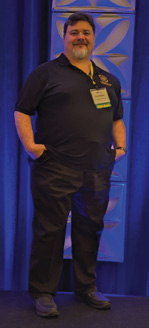 |
| Scott Bonner delivered the first day’s keynote. |
At that time, Bonner had been the library director for just more than a month. But the decisions he made and the partnerships he jumped into during the time of unrest won him great acclaim and helped outline a crisis strategy for public libraries. During 3 months of unrest in 2014—from the day of the shooting through the Nov. 24 announcement of a grand jury decision that did not indict the officer—FMPL stayed open to serve its neighbors, even while businesses around it were closed. In fact, nearby schools were closed to keep children and teachers safe, but that caused a problem for working parents. This led to one of FMPL’s most lauded actions: Bonner partnered with a group of teachers who wanted to keep school lessons going. They set up classrooms in the library’s meeting rooms and auditorium and in a nearby church. Organizers reached out to tell parents via social media and physical signs.
With about 200 children attending the so-called School of Peace, word got around. This seemed to be one bright story in a dark and stormy time. A reporter interviewed Bonner, at some point admitting, “We need a change in this story, and you’re it.” That reality-media tidbit was my favorite part of Bonner’s story. It’s just one reason why someone from your library always needs to be prepared to give interviews. You can be thrust into the limelight at any moment, and it could make or break your reputation or brand. In this case, FMPL ended up the hero of the story. After the protests and riots ended and after the national press wrote about how vital the library was, a lot happened: FMPL got hundreds of thousands of dollars in donations, Library Journal and Gale named it 2015 Library of the Year (libraryjournal.com/story/2015-galelj-library-of-the-year-ferguson-municipal-public-library-mo-courage-in-crisis), and soon afterward, it campaigned for a tax increase and won.
Data and Marcom Advice Both Matter
After that inspirational start, during the remainder of Wednesday, I was able to take in sessions on two topics I’m especially interested in, starting with data. Sophie Hollis from NC LIVE, a membership co-operative in North Carolina, shared numerous reasons why to always have data on hand, such as being prepared for unexpected opportunities to connect with funders or decision makers.
There are myriad places to harvest data from, such as usage reports from vendor tools and services, tracking participation in events, facilities usage counts, and patron stories. Once you have your content, Hollis said, make it impactful before sharing it. Ferret out lingo, ensure the message is clear, and include visuals whenever possible.
I also listened in on a session titled Craft the Message, Shape the Experience: Marcom at the Table. With a moderator posing questions to a duo of speakers, many good points were made in rapid succession. Let’s look at a sampling of what those professionals agreed on:
- Projects will benefit if marketing communication (marcom) people have a seat at the table from the beginning. They’d rather help shape priorities than react to them. They don’t want colleagues to bring them in at the end of planning, just in time to make posters.
- When everyone wants their own projects to get the full promotional treatment, you need guidelines to help avoid conflicts over which ones are the highest priority.
- Just because staff members might have fun making graphics doesn’t mean they’re good at it. Marketers sometimes need to be honest with other staffers and say their rogue posters are poorly designed. If you have professional designers on staff, use them. Also, templates are everyone’s friends.
- Make the time to analyze a project or campaign once it’s over in order to do it better next time.
A New Annual Marketing Award
Maria Atilano, board president of the Library Marketing Conference Group (LMCG), which plans the event, delivered lots of happy news to jump-start the second day. She began by saying that the LMCG had been able to award six scholarships to applicants so they could attend the conference for the first time. See all of the winners at librarymarketingconference.org/Scholarships.
Then, even bigger news: the announcement of the winners of the first Best of Marketing Awards, bestowed by the LMCG. Atilano explained there were two winners: one top academic library and one top public library. Plus, there were some honorable mentions from the field of 50-plus entries. The University of California–Santa Barbara’s library won the Academic/Special Library Best of Marketing Award for its USBC Reads campaign, and Chesapeake Public Library in Virginia won the Public Library Best of Marketing Award for its Dizzy Trading Cards campaign. Each winner took home a $1,500 prize, courtesy of sponsor hoopla Digital.
The keynote for this second day was presented by Kaetrena Davis Kendrick, who’s done award-winning research on low-morale experiences in libraries. Her presentation’s title describes her talk quite well—Signaling (Critical) Hope: Normalizing Self-Preservation and Collective Care in Library Workplace Communications. Although the airline shutdowns kept her from getting to St. Louis, Kendrick nonetheless gave a powerful talk via a live stream.
Kendrick certainly understands morale problems in libraries. Even as she steered the audience toward hope, she admitted that practicing hope is messy, uncomfortable, and contradictory. Hope itself isn’t enough. “We can hope all day,” she said. But “hope must come with action.” She acknowledged things such as toxic positivity and organizational trauma. While there are no magic bullets, her presentation and her “I see you” vibe seemed like a welcome salve to the crowd.
Later that morning, I took in a completely different topic—accessible design. Katie Rothley from Northville District Library in Michigan discussed design for both web and print information. She pointed out a number of things that accidental marketers and accidental designers need to take into account. For example, always use person-first language. Instead of writing “a disabled person,” write “a person with a disability.” Also, remember that numerous disabilities are not visible. These include dyslexia, low-vision, deafness or hearing problems, and cognitive impairments. In addition, always include alt text to describe images. Finally, whether you’re designing posters or webpages, work with screen readers in mind. Understand that screen-reading software can’t read text within images, can’t decipher icons that aren’t labeled, and doesn’t do well with walls of text or with paragraphs that are centered. Rothley pointed listeners to digital.gov to find lists that will help them comply with all manner of federal accessibility requirements.
I’ll admit, I was attracted to my final session as soon as I read the name: From “I Didn’t Know” to “Whoa!”: Promoting Library Digital Resources. The opening line of the description is this: “Are you tired of hearing ‘I didn’t know you had that!’ about the digital resources your library offers?” To be honest, they had me at “tired of hearing.” The number of attendees in the huge conference room assured me that I wasn’t alone.
Michelle Newcomb from the Manhattan-Elwood Public Library District in Illinois teamed up with Leigh Gaddy from NoveList to explain that email marketing offers the best ROI for the time and energy it takes. When Newcomb was new in her job as communications and development coordinator, she asked colleagues, “What do patrons not know that drives you bananas?” This helped her pinpoint the products and services that the library needed to communicate about. Her approach to contacting people about the right resources is simple: Identify the problem that a digital resource solves, write key messages to use for that database or tool, design graphically interesting emails to send to people who share the same problem, and always track email performance (open rates, click-through rates, etc.).
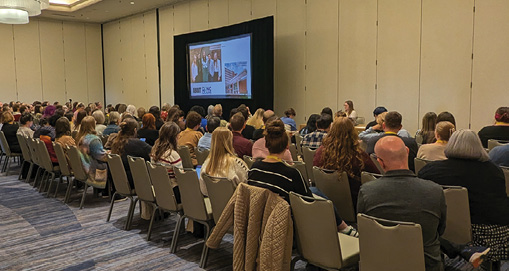 |
| The NC Live presentation packed one of the larger breakout-session rooms. |
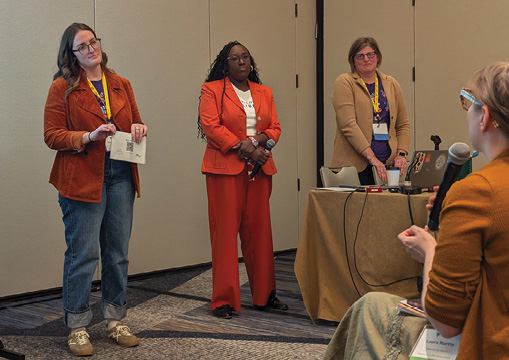 |
Presenters who insisted that marketing communications workers have a seat at the table (left to right: Claire Huber, Kiosha Boyles, Stacy Opitz)
take a question from an audience member. |
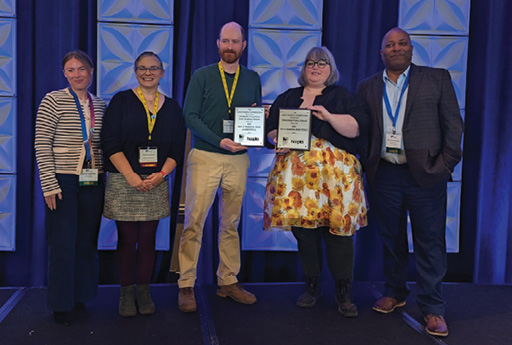 |
Library Marketing Conference Group board president Maria Atilano (second from left) poses with both Best of Marketing Award winners,
who are flanked by staffers from award sponsor hoopla Digital. |
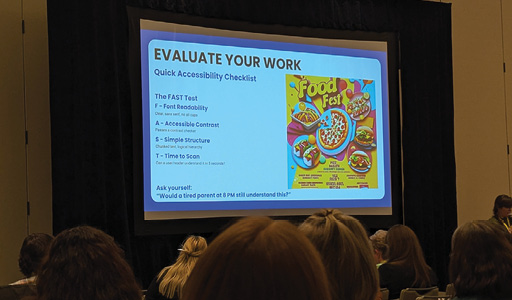 |
| An example of poor poster design shown at the accessible design session. |
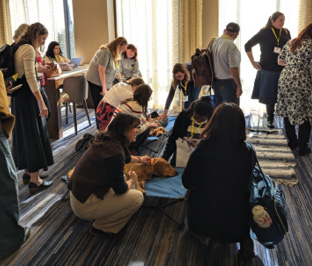 |
| Conference-goers happily crowd around four sweet therapy dogs. |
Thinking Back Over LMCC 2025
LMCC 2025 had many of the same pluses that make it great every year—thought-provoking keynotes, a wealth of sessions to choose from, a Swag Swap room full of good ideas, and friendly people all around. There were a few new features this year, and, thinking back, many of them related to the wellness of the attendees themselves.
One morning (too early for me!), yoga was offered, and every available space was filled. One afternoon, four therapy dogs were on-site, and their little corner area was bustling with folks who wanted a few minutes with a furry friend. One early evening had a 90-minute bring-your-own-craft space where people could gather to interact—or not. I imagine that all of these ideas sprung from previous post-conference surveys and requests. It’s hard to manage the wants of so many people, but I must say, kudos to the conference organizers for adding all of these little things, which surely aren’t that little when you’re trying to organize and afford them.
I was lucky to be at LMCC again. In fact, I’m one of just a handful of people who have been able to attend all 11 conferences. Believe it or not, my luck continued through my trip home. I was able to share a ride to the airport with a librarian who I really connected with. Later, when I boarded the plane, another conference-goer happened to sit behind me, and we really hit it off—and may work on something together later. When the plane’s door closed, I realized I had a row all to myself again. It was Row 11, naturally.
If you’re inclined to attend next year, the Library Marketing and Communications Conference will be in St. Louis again, Nov. 10–11. If we’re lucky, I’ll see you there. |